

When identical DNA results can be the same but the evidence totally different, you need more than the DNA report alone.
Two Knives. Different Evidence.
Two forensic biology reports with identical reported results. Here is what both reports said:
“The DNA recovered has the same profile as the defendant. This profile is greater than 100 billion times more likely if it has originated from Mr X than if it has originated from another unknown, unrelated individual in the Australian population.”
Same item type. Same DNA match. Same statistic. Same wording. Now let me tell you what the reports did not say and why the difference between these two pieces of evidence could not be more significant to a client facing serious criminal charges.
Knife One
The first knife had a single, well-defined bloodstain sitting on the flat of the blade. Circular in shape. Undisturbed edges. The pattern was consistent with a passive drip, that is, blood falling from directly above and landing on a stationary surface. A properly interpreted forensic report would tell you this:
“A DNA profile matching that of the defendant was obtained from a passive blood stain which appears to have dripped onto the blade from directly above. In my opinion, these findings support the proposition that the defendant was in close proximity to the knife whilst injured and bleeding but the knife has not been used to cause injury.”
The DNA matches Mr X. But the physical evidence of the stain itself suggests the knife was not the weapon. Mr X may have been bleeding near it. That is all the evidence supports.
Knife Two
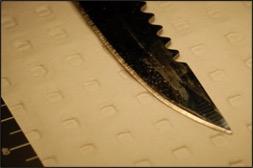
The second knife told an entirely different story, but the DNA report looked identical to the first. This blade had heavy, wiped blood staining across its surface. Consistent with contact between the blade and a bleeding wound. There was also apparent fat staining, biological material consistent with a penetrating injury to soft tissue. And the blood itself appeared diluted, consistent with an attempt to clean the weapon after use. A properly interpreted forensic report would tell you this:
“The presence of the wiped bloodstains and apparent fat staining on the knife are indicative of the knife having been used to cause a penetrative injury to Mr X. The diluted blood staining in my opinion could be accounted for by an attempt to clean the knife.”
Same DNA result. Completely different evidentiary meaning. One knife places Mr X near a weapon whilst injured. The other indicates this may be the weapon that injured Mr X.
Why Are the Reports the Same?
This is the question that should concern every criminal defence lawyer reading this newsletter. The trend in forensic biology reporting in Australia is toward simplification. Laboratories are under pressure. Reports are being stripped back, in some cases the DNA laboratory is not even performing the biological testing. They are receiving a sample in a tube to be submitted directly for DNA analysis.
What reaches your desk and ultimately the court is increasingly a bare statement of the DNA match and the accompanying statistic. The result and the statistic are facts. But they are not the interpretation. And without the interpretation, critically important information is lost entirely. The appearance of the stain. The pattern of the bloodstaining. The distribution across the item. The presence or absence of biological material consistent with specific types of injury. When that layer of interpretation is absent from the report, the jury sees two identical results and draws its own conclusions. In my experience, those conclusions are not always the right ones.
Forensic evidence does not exist to prove guilt. It exists to assist the court in understanding what the physical evidence means. A competent, independent forensic scientist will consider not just the proposition put forward by the prosecution, but alternative explanations that are equally consistent with the physical evidence.
What to Look For When You Receive a Forensic Biology Report
When a forensic biology report arrives in a matter involving biological evidence on a physical item — a weapon, clothing, a surface — these are the questions I would encourage you to ask before accepting the report at face value:
Has the appearance and condition of the stain been described? The physical characteristics of a bloodstain — its shape, distribution, and pattern — can be critical information and as significant as the DNA result. If the report does not describe the stain, you are missing critical context.
Has any presumptive or confirmatory testing been conducted? Presumptive testing screens for the presence of biological fluids such as blood or semen. Confirmatory testing can establish their presence definitively, but not always. If neither has been conducted, the DNA result exists in a vacuum. You do not know what biological material the DNA came from, or whether it is relevant to the alleged offence at all.
Has the scientist provided an opinion or just a result? A result tells you that DNA matching your client was found. An opinion tells you what that finding means.
Does the reported finding actually support the prosecution’s allegation? This is the most important question of all. In the knife example above, the DNA result on Knife One could be argued to actively support a defence case that Mr X was present and injured but that knife was not used. Whereas Knife Two supports that the knife caused injury. With current practises, that interpretation was available from the evidence but would not be routinely put in a report.
This does not just apply to bloodstains. This happens in sexual assault evidence as well where just the presence of spermatozoa is reported. There are very different interpretations that can arise depending on whether one spermatozoa is observed than if many spermatozoa with tails are observed.
An Independent Review Can Change the Evidence
If you have received a forensic biology report in a serious criminal matter and it contains nothing more than a DNA match and a statistic, I would strongly encourage you to seek an independent review before the matter proceeds further. An independent forensic scientist will examine not just the DNA result, but the underlying case materials, the examination notes, the photographs of exhibits, the stain descriptions, the biological testing results, and the raw data behind the DNA profile. From that material, a complete and properly contextualised opinion can be formed. In some cases, that review will confirm the prosecution’s position. In others, it will reveal that the evidence supports an entirely different conclusion. In either case, you will know. And your client deserves nothing less.
Further Reading
Author Bio

Jae Gerhard is a Forensic DNA Expert and the Principal Forensic Scientist at Independent Forensic Services, bringing over two decades of frontline experience in forensic biology.
Specialising in DNA analysis, STRmix™, biological fluid examination, and bloodstain pattern interpretation, Jae now works independently with criminal defence teams to review and challenge forensic evidence. Her mission is simple: to ensure the science presented in court is accurate, balanced, and truly understood.
DNA Expert Witness Testimony
We’re passionate about ensuring forensic biology and DNA evidence is presented to the courts in an impartial, yet comprehensive manner, and that potentially misleading evidence isn’t relied upon. We also want our clients to understand the strengths and limitations of forensic evidence in their cases.
Independent
As an independent forensic service provider, we offer unbiased and impartial analysis. Our independence guarantees that our findings are based solely on scientific evidence, free from external influences. This objectivity is crucial in ensuring the credibility and reliability of our forensic reports.
Confidential
We understand the sensitive nature of forensic investigations. Confidentiality is a cornerstone of our services. We handle all cases with the highest level of discretion, ensuring that your privacy and the integrity of the investigation are maintained at all times.
Trusted
Integrity is at the heart of everything we do. We are committed to ethical practices and uphold the highest standards of honesty and transparency in all our investigations. You can trust that our findings are accurate, thoroughly vetted, and presented with complete integrity.
Professional
Our team adheres to the highest standards in forensic science, ensuring that every case is handled with the utmost care and precision. We strive for excellence in all our services, providing reliable and accurate forensic analysis.
Highly Experienced
Our team comprises forensic experts with extensive experience across various forensic disciplines. With years of practical experience and advanced training, our professionals bring a wealth of knowledge to each investigation. This expertise ensures that we deliver top-tier forensic solutions tailored to your specific needs.
Approachable
We work closely with you, offering guidance and support throughout the investigation, ensuring you feel confident and informed. Our team is approachable and dedicated to making the forensic process understandable and straightforward.
Get Started
Choosing Independent Forensic Services means partnering with a team that values professionalism, experience, approachability, independence, confidentiality, and integrity. Trust us to provide the forensic expertise you need to achieve justice.
How We Can Help You
With Independent Forensic Services, you gain access to a team of experts.




An Expert Team Lead by Jae Gerhard
Jae Gerhard is a Forensic DNA Expert and the Principal Forensic Scientist at Independent Forensic Services, bringing over two decades of frontline experience in forensic biology. She has worked on some of Australia’s most complex and high‑profile cases with the Australian Federal Police and New South Wales Police, including the Special Commission of Inquiry into LGBTIQ Hate Crimes, National Crime Authority bombing, Claremont serial killer case, Lin Family murders, murder of Michelle Beets as well as international disaster victim identification operations such as the 2002 Bali Bombing, 2003 Australian Embassy bombing and 2004 Asian tsunami.
Specialising in DNA analysis, STRmix™, biological fluid examination, and bloodstain pattern interpretation, Jae now works independently with criminal defence teams to review and challenge forensic evidence. Her mission is simple: to ensure the science presented in court is accurate, balanced, and truly understood.