
Seifeddine v R: DNA Evidence of the Accused Was Found on the Trigger of a Gun.
Case closed? Not quite.
Case Background
Mr Seifeddine was a part-time worker at a cafe where a search warrant at the premises located a number of firearms held in a bucket, which had been secreted in a wall cavity. DNA matches for Mr Seifeddine were found in various places, including on the rim of the bucket and on the trigger of one firearm, which had been wrapped in a sock.
Seifeddine v R [2021] NSWCCA 214
Initial Outcome
Mr Seifeddine was initially convicted of firearm possession in 2019, with some of the critical evidence in this matter being the trace DNA on the bucket and firearm, as well as CCTV evidence of him accessing the wall cavity.
Challenging the DNA Evidence: Secondary Transfer and the Fallibility of DNA Matches
The simple fact that needs to be clearly understood is that the presence of DNA on an object does not offer an explanation for how the DNA came to be there.
A person who regularly enters any space, as Mr Seifeddine did as a part-time worker who frequently accessed the area around where the firearms were hidden, will ‘shed’ DNA in multiple places and in multiple quantities, including shedding more where friction is involved, such as twisting door knobs or opening buckets (like the one the firearms were held in).
This DNA can be transported around the space by anyone who, for example, touches the same door knob or opens the same bucket. Various factors can also affect the DNA transfer, including the porosity of materials, with some materials transferring DNA more easily than others.
Secondary Transfer Opportunities Across Time
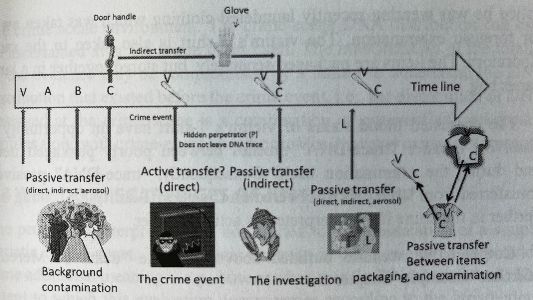
Image courtesy of Misleading DNA Evidence: Reasons for Miscarriages of Justice by Peter Gill.
The Scientific Case Against the Conviction
In order to form an opinion on how DNA could be deposited, there is a mechanism known as activity level assessment that can be performed. This, like the likelihood ratio, requires the formulation of two propositions to evaluate. Scientific data is then used to inform these propositions and calculate a likelihood ratio.
When it comes to the deposition of trace DNA (that is, DNA that cannot be attributed to a biological fluid), it is extraordinarily difficult to find sufficient and applicable published data in order to calculate some form of probability to provide an opinion on how the DNA was deposited.
Experimental data has also demonstrated that neither the quantity of DNA recovered nor the quality of the DNA profile obtained can be reliably used to determine the nature of deposition, i.e., direct or indirect DNA transfer. This is due to the transfer, persistence, and recovery of trace DNA on/from persons and/or objects being a highly complex and multifactorial process, as outlined in the image above.
Outcome: Conviction Overturned Due to Possibility of Secondary Transfer
At first glance, the DNA evidence, particularly matches appearing on the trigger of the gun, is conclusive evidence. However, careful analysis of the collection of the evidence, which was recorded by police, showed enough opportunities for secondary contamination to occur that the ruling was quashed. These included:
- The police gathering evidence using the same pair of gloves despite touching numerous surfaces.
- The possibility that the DNA match on the rim of the bucket was a result of Mr Seifeddine previously opening the bucket as part of his day-to-day responsibilities.
- The possibility of Mr Seifeddine’s DNA being on the sock which held the gun through some other means, and this being transferred to the gun (as the sock is a highly porous material), including the trigger, while being pulled out by the police.
The Conclusion
DNA evidence is not fallible. It merely provides a probability that DNA found on an object may have originated from an individual. Unless a very specific evaluation has been conducted to inform at an activity level (a contentious practice for trace DNA), this probability remains uncertain.
When seeking or challenging a conviction based on DNA evidence, it is imperative that any limitations to the evidence are reviewed thoroughly, and any expert witnesses involved clearly outline them to ensure the court is able to appropriately evaluate the evidence.
Author Bio
Jae Gerhard is a Forensic DNA Expert and the Principal Forensic Scientist at Independent Forensic Services, bringing over two decades of frontline experience in forensic biology.
Specialising in DNA analysis, STRmix™, biological fluid examination, and bloodstain pattern interpretation, Jae now works independently with criminal defence teams to review and challenge forensic evidence. Her mission is simple: to ensure the science presented in court is accurate, balanced, and truly understood.
DNA Expert Witness Testimony
We’re passionate about ensuring forensic biology and DNA evidence is presented to the courts in an impartial, yet comprehensive manner, and that potentially misleading evidence isn’t relied upon. We also want our clients to understand the strengths and limitations of forensic evidence in their cases.
Independent
As an independent forensic service provider, we offer unbiased and impartial analysis. Our independence guarantees that our findings are based solely on scientific evidence, free from external influences. This objectivity is crucial in ensuring the credibility and reliability of our forensic reports.
Confidential
We understand the sensitive nature of forensic investigations. Confidentiality is a cornerstone of our services. We handle all cases with the highest level of discretion, ensuring that your privacy and the integrity of the investigation are maintained at all times.
Trusted
Integrity is at the heart of everything we do. We are committed to ethical practices and uphold the highest standards of honesty and transparency in all our investigations. You can trust that our findings are accurate, thoroughly vetted, and presented with complete integrity.
Professional
Our team adheres to the highest standards in forensic science, ensuring that every case is handled with the utmost care and precision. We strive for excellence in all our services, providing reliable and accurate forensic analysis.
Highly Experienced
Our team comprises forensic experts with extensive experience across various forensic disciplines. With years of practical experience and advanced training, our professionals bring a wealth of knowledge to each investigation. This expertise ensures that we deliver top-tier forensic solutions tailored to your specific needs.
Approachable
We work closely with you, offering guidance and support throughout the investigation, ensuring you feel confident and informed. Our team is approachable and dedicated to making the forensic process understandable and straightforward.
Get Started
Choosing Independent Forensic Services means partnering with a team that values professionalism, experience, approachability, independence, confidentiality, and integrity. Trust us to provide the forensic expertise you need to achieve justice.
How We Can Help You
With Independent Forensic Services, you gain access to a team of experts.



An Expert Team Lead by Jae Gerhard
Jae Gerhard is a Forensic DNA Expert and the Principal Forensic Scientist at Independent Forensic Services, bringing over two decades of frontline experience in forensic biology. She has worked on some of Australia’s most complex and high‑profile cases with the Australian Federal Police and New South Wales Police, including the Special Commission of Inquiry into LGBTIQ Hate Crimes, National Crime Authority bombing, Claremont serial killer case, Lin Family murders, murder of Michelle Beets as well as international disaster victim identification operations such as the 2002 Bali Bombing, 2003 Australian Embassy bombing and 2004 Asian tsunami.
Specialising in DNA analysis, STRmix™, biological fluid examination, and bloodstain pattern interpretation, Jae now works independently with criminal defence teams to review and challenge forensic evidence. Her mission is simple: to ensure the science presented in court is accurate, balanced, and truly understood.