
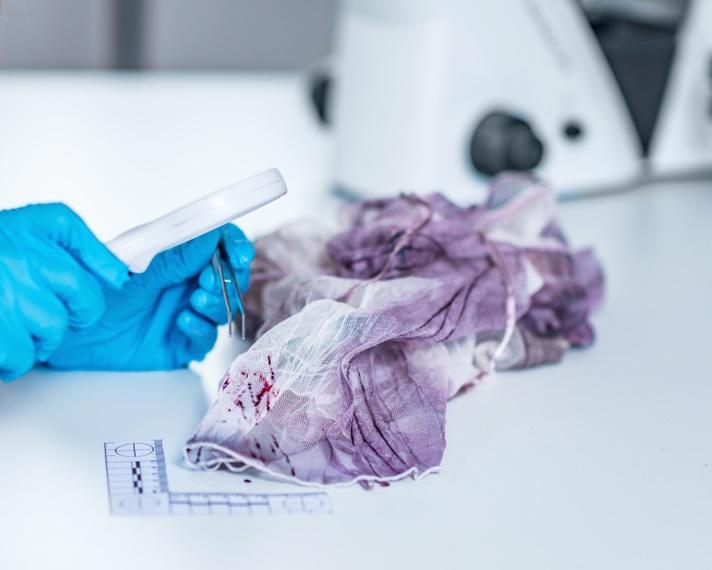
A crime scene officer’s statement can make a test sound far more conclusive than it is.
Forensic evidence carries weight. Judges, juries and prosecutors often treat a scientific-sounding statement as settled fact. But a statement being written down in a report or witness statement does not make it correct. Sometimes the problem is not the science itself, but how the science is reported.
A Case in Point: The “Confirmatory” Saliva Test
Recently, we reviewed a crime scene officer’s statement that included the following description:
“A confirmatory test is one which is highly specific for a particular substance. Rapid Stain Identification (RSID™) tests consist of a small plastic cassette containing a chemically impregnated test strip. A sample of the questioned substance is mixed with a liquid solution; a small amount of the resulting mixture is placed into the RSID™ test cassette. A positive test result indicates the presence of human saliva. A negative test result indicates either the sample is not human saliva or the quantity of human saliva in the sample is below the level this test can detect.”
On its face, this reads as authoritative and reassuring. A positive result means saliva. Simple.
It is not correct.
What the Statement Gets Wrong
A confirmatory test, by the statement’s own definition, must be highly specific for the substance in question. The RSID™ saliva test does not meet that standard. It is known to react with a range of other biological fluids and substances, including:
- Breast milk
- Sweat
- Urine
- Semen
- Vaginal fluids
- Faeces
- Organic acid-containing substances, such as some soft drinks and cleaning agents
A positive result could occur in the presence of saliva, but it is not proof that saliva is present. Given the above list, it can hardly be considered a confirmatory test for the presence of saliva at all.
It is hard to see the failure to disclose these limitations as anything other than an attempt to bolster the report for the Prosecution. It is misleading and biased.
Casey et al (2010) The sensitivity and specificity of the RSID-saliva kit for the detection of human salivary amylase in the Forensic Science Laboratory, Dublin, Ireland
Foley et al (2020) Effects of organic acids and common household products on the occurrence of false positive test results using immunochromatographic assays
Stroud et al (2023) A comprehensive study into false positive rates for ‘other’ biological samples using common presumptive testing methods
Why This Matters for Your Client
The distinction between a presumptive and a confirmatory result can change the entire complexion of a case. If the Crown relies on a positive RSID™ result to establish that saliva was present, and the test is described as “confirmatory”, several things can follow:
- The evidence may be overstated. A jury told a test is confirmatory may give it far more weight than it deserves.
- Alternative explanations are lost. If a stain could just as easily be sweat, a soft drink or a cleaning product, the inference the prosecution seeks to draw may not be open.
- Cross-examination opportunities are missed. Without scrutiny, an inaccurate description can pass unchallenged from statement to evidence in chief.
Questions Worth Asking
When a forensic report or statement describes a test as confirmatory or specific, consider asking:
- What is the source of the claim that the test is specific? Has it been verified against the manufacturer’s information and the published literature?
- What known cross-reactivities does the test have, and were they considered?
- Were any further tests carried out to support the result, such as DNA analysis, and what did they show?
- Was the author qualified to describe the limitations of the method?
- Was the result described in the report as presumptive, or as more certain?
The Takeaway
Forensic reports are written by people, and people make errors, rely on assumptions, repeat information that was never properly checked and can be influenced by biasing factors. Before accepting what is put in front of you, please take the time to verify it.
An independent review can identify overstated claims, unsupported conclusions and methodological limitations before they reach the courtroom and you can be forearmed to challenge the Prosecution’s narrative.
Author Bio
Jae Gerhard is a Forensic DNA Expert and the Principal Forensic Scientist at Independent Forensic Services, bringing over two decades of frontline experience in forensic biology.
Specialising in DNA analysis, STRmix™, biological fluid examination, and bloodstain pattern interpretation, Jae now works independently with criminal defence teams to review and challenge forensic evidence. Her mission is simple: to ensure the science presented in court is accurate, balanced, and truly understood.
DNA Expert Witness Testimony
We’re passionate about ensuring forensic biology and DNA evidence is presented to the courts in an impartial, yet comprehensive manner, and that potentially misleading evidence isn’t relied upon. We also want our clients to understand the strengths and limitations of forensic evidence in their cases.
Independent
As an independent forensic service provider, we offer unbiased and impartial analysis. Our independence guarantees that our findings are based solely on scientific evidence, free from external influences. This objectivity is crucial in ensuring the credibility and reliability of our forensic reports.
Confidential
We understand the sensitive nature of forensic investigations. Confidentiality is a cornerstone of our services. We handle all cases with the highest level of discretion, ensuring that your privacy and the integrity of the investigation are maintained at all times.
Trusted
Integrity is at the heart of everything we do. We are committed to ethical practices and uphold the highest standards of honesty and transparency in all our investigations. You can trust that our findings are accurate, thoroughly vetted, and presented with complete integrity.
Professional
Our team adheres to the highest standards in forensic science, ensuring that every case is handled with the utmost care and precision. We strive for excellence in all our services, providing reliable and accurate forensic analysis.
Highly Experienced
Our team comprises forensic experts with extensive experience across various forensic disciplines. With years of practical experience and advanced training, our professionals bring a wealth of knowledge to each investigation. This expertise ensures that we deliver top-tier forensic solutions tailored to your specific needs.
Approachable
We work closely with you, offering guidance and support throughout the investigation, ensuring you feel confident and informed. Our team is approachable and dedicated to making the forensic process understandable and straightforward.
Get Started
Choosing Independent Forensic Services means partnering with a team that values professionalism, experience, approachability, independence, confidentiality, and integrity. Trust us to provide the forensic expertise you need to achieve justice.
How We Can Help You
With Independent Forensic Services, you gain access to a team of experts.


An Expert Team Led by Jae Gerhard
Jae Gerhard is a Forensic DNA Expert and the Principal Forensic Scientist at Independent Forensic Services, bringing over two decades of frontline experience in forensic biology. She has worked on some of Australia’s most complex and high‑profile cases with the Australian Federal Police and New South Wales Police, including the Special Commission of Inquiry into LGBTIQ Hate Crimes, National Crime Authority bombing, Claremont serial killer case, Lin Family murders, murder of Michelle Beets as well as international disaster victim identification operations such as the 2002 Bali Bombing, 2003 Australian Embassy bombing and 2004 Asian tsunami.
Specialising in DNA analysis, STRmix™, biological fluid examination, and bloodstain pattern interpretation, Jae now works independently with criminal defence teams to review and challenge forensic evidence. Her mission is simple: to ensure the science presented in court is accurate, balanced, and truly understood.